See also:
👉 Ordering steak — doneness levels & steak cuts »
👉 Vouloir Word of the Day lesson »
Level A1 (Beginner)
🎧 Audio by Marie Assel Cambier — native speaker & pro voice artist from France
✅ Meaning
✅ Pronunciation
✅ Example sentences
✅ Related Words & Expressions
✅ Related lessons
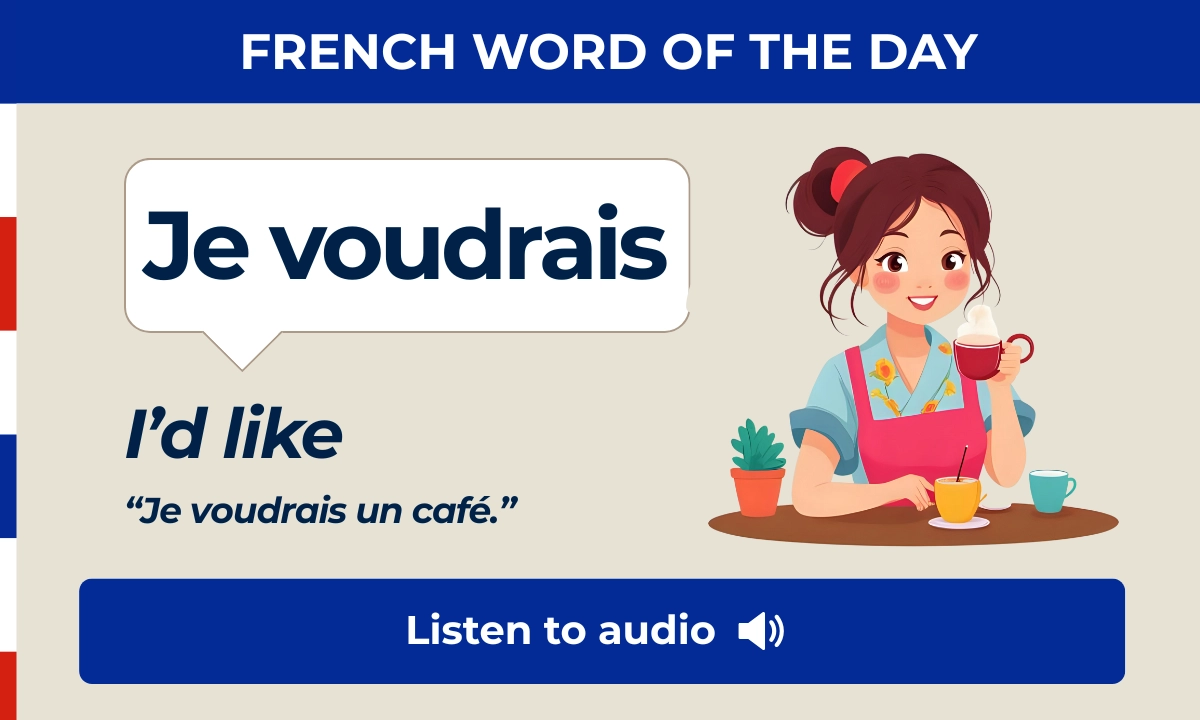
📘 Je voudrais meaning
Je voudrais is the polite way to say “I’d like” in French. It’s the conditional form of vouloir (to want) and is commonly used for making requests or ordering in restaurants. (See examples below.)
🎧 Je voudrais pronunciation
Je voudrais is pronounced /ʒə vudʁɛ/ in IPA. The j sounds like the “s” in measure, ou like “oo” in food, and the French r is pronounced in the throat.
📝 French and English Examples
How to say “I’d like” in French
Je voudrais + noun
The most common way to use je voudrais is with a noun — perfect for ordering in restaurants. The structure is: je voudrais + item + s’il vous plaît (please).
Je voudrais un café.
I’d like a coffee.
Je voudrais un croissant.
I’d like a croissant.
Je voudrais du vin blanc, s’il vous plaît.
I’d like some white wine, please.
Je voudrais la salade niçoise.
I’d like the Niçoise salade.
🎧 French clicks when you hear it.
That’s why I recommend French Today’s À Moi Paris course — 100% audio-based, with clear step-by-step lessons.
👉 Discover it here »
👉 Read my review »
Disclosure: This is an affiliate link. If you buy the course I will earn a small commission.
Je voudrais + infinitive
Je voudrais can also be followed by a verb in the infinitive form to mean “I’d like to”.
Je voudrais acheter une voiture.
I’d like to buy a car.
Je voudrais vs. je veux
French learners should be careful — je voudrais (I’d like) and je veux (I want) may seem similar, but they send very different messages.

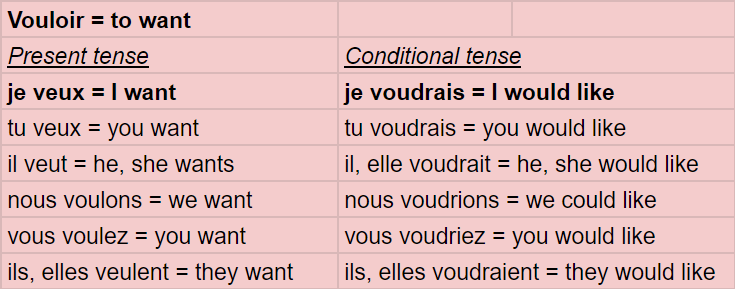
What is voudrais?
Je voudrais is the conditional form (“would” tense) of vouloir (to want). Literally, it means “I would want.”
When speaking with friends or close acquaintances, it’s fine to use je veux. For example, you might ask a friend: Qu’est-ce que tu veux ? (What do you want?).
However, in formal situations or when addressing strangers, je veux can come across as impolite. In these cases, choose je voudrais instead.
Je veux un café.
I want a coffee.
J’aimerais also means “I would like”
Another common way to say “I would like” is j’aimerais, the conditional form of aimer (to like, to love).

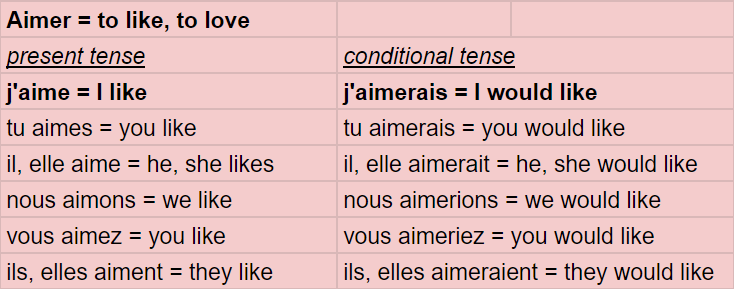
When talking about what you’d like to do, j’aimerais and je voudrais are interchangeable. But when requesting something — for example, ordering food — use je voudrais.
- Je voudrais partir demain. → I would like to leave tomorrow.
- J’aimerais partir demain. → I would like to leave tomorrow.
Je voudrais bien and j’aimerais bien
Two common expressions are je voudrais bien and j’aimerais bien. Both can mean “gladly” or “I’d really like to,” and in casual conversation they’re often interchangeable.
The difference is subtle: je voudrais bien tends to feel more immediate, while j’aimerais bien can also express a longer-term wish.
For example, if someone asks, Voudriez-vous dîner au restaurant français ? (Would you like to have dinner in a French restaurant?), you might reply:
Oui, je voudrais bien.
I’d like to.
Oui, j’aimerais bien.
I’d really like to.
When followed by an infinitive, these expressions mean “I’d really like to.” For example: Je voudrais bien aller au cinéma. (I’d really like to go to the movies.)
Donnez-moi and donne-moi
Besides je voudrais, there are other ways to say “I’d like” in French. Donnez-moi and donne-moi both mean “give me” — the formal and informal imperative forms of donner (to give), respectively.
Donnez-moi deux kilos de tomates.
Give me two kilos of tomatoes.
👉 This lesson explains the verb donner in detail. »
💬 Related words & expressions
- Puis-je avoir… ? – May I have…? (formal)
- Pourrais-je… ? – Could I…? (very polite)
- Est-ce que je peux… ? – Can I…?
- Je souhaite… – I wish to / I hope to
- Je désire… – I desire / I would like (formal, less common in speech)
- Commander – To order (e.g., in a restaurant)
📚 Related French Lessons
Now that you’ve mastered je voudrais, check out my lesson on the verb demander (to ask for), a word that often causes confusion for students.
Discover more on FrenchLearner
👉 French Word of the Day »
👉 French for beginners guide »
👉 French song lyrics hub »
👉 French Vocabulary lists »