
Partir means ‘to leave’ in French. The conjugation of partir in the present tense is je pars (I leave), tu pars (you leave), il, elle part (he, she leaves), nous partons (we leave), vous partez (you leave) and ils, elles partent (they leave). Partir is an irregular verb.

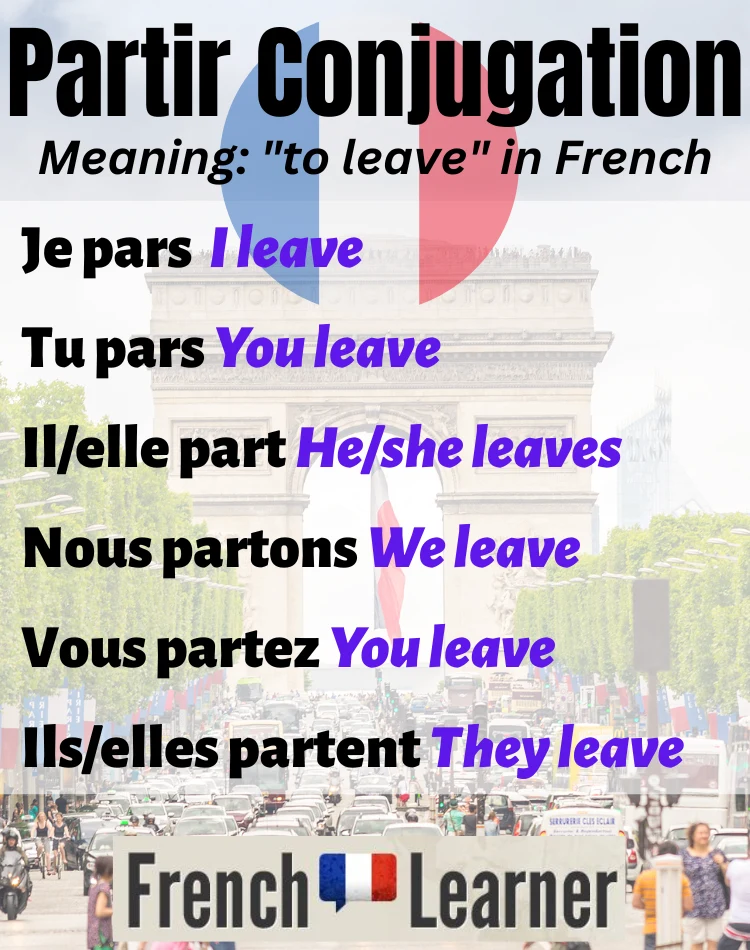
Partir conjugation table: quick overview

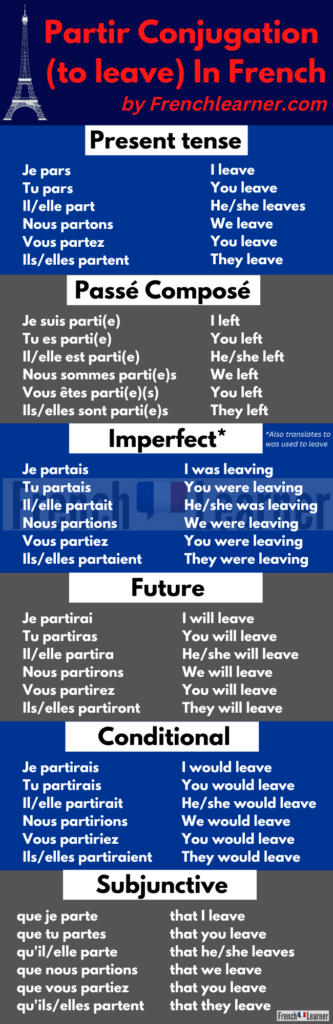
Partir conjugation charts
Present tense
In the present tense, je pars translates to ‘I leave’, ‘I am leaving’ and ‘I do leave’.
| Je pars | I leave | Je pars demain à midi. | I'm leaving tomorrow at noon. |
| Tu pars | You leave (singular, infomral) | A quelle heure est-ce que tu pars? | What time are you leaving? |
| Il, elle part | He, she leaves | Elle part en vacances en Suisse. | She's going to Switzerland on vacation. |
| Nous partons | We leave | Nous partons avec Thomas la semaine prochaine. | We're leaving with Thomas next week. |
| Vous partez | You leave (plural, formal) | Pourquoi est-ce que vous partez avant les autres? | Why are you leaving before the others? |
| Ils, elles partent | They leave | Ils partent de la maison très tôt le matin. | They leave the house very early in the morning. |
Passé composé
In the passé composé, a commonly used French past tense for events which occurred at specified times, je suis parti means ‘I left’. Partir requires the use of être (to be) an auxiliary verb in the passé composé.
| Je suis parti(e) | I left | Je suis parti du bureau hier soir à dix-neuf heures. | I left the office last night at 7:00pm. |
| Tu es parti(e) | You left (familiar, singular) | A quelle heure est-ce que tu es parti de la masion? | What time did you leave the house? |
| Il, elle est parti(e) | He, she left | Est-ce qu'elle est partie avec Pierre? | Did she leave with Pierre? |
| Nous sommes parti(e)s | We left | Nous ne sommes pas partis avant tes amis. | We didn't leave before your friends. |
| Vous êtes parti(e)(s) | You left (formal, plural) | Pourquoi est-ce que vous êtes partis si tôt? | Why did you leave so early? |
| Ils, elles sont parti(e)s | They left | Ils sont partis avant la fin de la soirée. | The left before the end of the evening party. |
Imperfect tense
In the imperfect (l’imparfait), a French past tense used for describing actions which occurred an unspecified times, je partais translates to ‘I was leaving’, ‘I used to leave’ and ‘I left’.
| Je partais | I was leaving, used to leave | Quand j'étais au collège, je partais de la masion à sept heures du matin. | When I was in middle school I used to leave the house at 7:00am. |
| Tu partais | You were leaving, used to leave (informal, singular) | Dans le passé tu partais avant ta femme. | In the past you used to leave before your wife. |
| Il, elle partait | He, she was leaving used to leave | Elle partait du bureau quand le téléphone a sonné. | She was leaving the office when the phone rang. |
| Nous partions | We were leaving, used to leave | Nous partions de bonne heure pour faire du ski. | We used to leave early to go skiing. |
| Vous partiez | You were leaving, used to leave (formal, plural) | Vous partiez de l'hôtel quand le taxi est arrivé. | You were leaving the hotel when the taxi arrived. |
| Ils, elles partaient | They were leaving, used to leave | Ils partaient de l'école quand le professeur est arrivé. | They were leaving the school when the teacher arrived. |
Future tense
In the future tense (le futur simple), je partirai translates to ‘I will leave’.
| Je partirai | I will leave | Je partirai demain si j'ai la voiture. | I'll leave tomorrow if I have the car. |
| Tu partiras | You will leave (singular, informal) | A quelle heure est-ce que tu partiras? | What time will you leave? |
| Il, elle partira | He, she will leave | Il ne partira pas avant Marie. | He won't leave before Marie. |
| Nous partirons | We will leave | Nous partirons demain s'il fait beau. | We'll leave tomorrow if it's nice out. |
| Vous partirez | You will leave (plural, formal) | Est-ce que vous partirez en vacances cette année? | Will you go on vacation this year? |
| Ils, elles partiront | They will leave | Elles partiront avant la fin de la soirée. | They will leave before the end of the party. |
Conditional tense
In the conditional tense (le conditionnel), je partirais translates to ‘I would leave’.
| Je partirais | I would leave | Je partirais demain s'il faisait beau. | I'd leave tomorrow if it were nice out. |
| Tu partirais | You would leave (singular, informal) | Tu partirais en vacances si tu avais plus de temps libre. | You'd go on vacation if you had more free time. |
| Il, elle partirait | He, she would leave | Il partirait mais la soirée n'est pas terminée. | He'd leave but the party isn't over. |
| Nous partirions | We would leave | Nous partirions demain mais les employées du SNCF font grève. | We'd leave tomorrow but the SNCF employees are on strike. |
| Vous partiriez | You would leave (plural, formal) | Partiriez-vous en vacances si vous aviez plus de temps libre? | Would you go on vacation if you had more free time? |
| Ils, elles partiraient | They would leave | Ils partiraient demain s'ils avaient la voiture. | They'd leave tomorrow if they had the car. |
Subjunctive mood
The French use the subjunctive mood (le subjonctif) to express wishes, emotions and doubts. Que je parte translates to ‘that I leave’.
| que je parte | that I leave | Il faut que je parte tout de suite. | I need to leave right away. |
| que tu partes | that you leave (singular, informal) | Elle veut que tu partes demain matin. | She wants you to leave tomorrow morning. |
| qu'il, elle parte | that he, she leaves | Je suis triste qu'elle parte avant nous. | I'm sad she's leaving before us. |
| que nous partions | that we leave | Il faut que nous partions avant janvier. | We need to leave before January. |
| que vous partiez | that you leave (plural, formal) | Je doute que vous partiez en vacances cette année. | I doubt you're going on vacation this year. |
| qu'ils, elles partent | that they leave | Je ne pense pas qu'ils partent avant les autres. | I don't think they're leaving before the others. |
Partir usages
Before the conjugation charts (see below), we’ll explore several usage of partir.
1. To leave
The most basic usage of partir is simply “to leave”. For example:
- Je pars dans une heure. I’m leaving in one hour.
2. To leave from
In the context of “to leave from”, partir is followed by the preposition de then the name of the place.
- Je pars de la masion. I’m leaving the house.
3. To go on vacation
The expression partir en vancances means to go on vacation.
- La famille part en vacances dans les Alpes. The family goes on vacation in the Alps.
4. To pass away
Partir can also mean to pass away.
- Son grand-père est parti en juillet. His grandfather passed away in July.
