

In French, the word for weather is le temps. To talk about the weather, say, Il fait plus the specific weather vocabulary word. For example, Il fait du soleil (It’s sunny out), Il fait froid (It’s cold out), Il fait du vent (It’s windy out) and Il pleut (It’s raining out). This page will explore French weather words and phrases in depth.

French weather vocabulary
How to describe the weather in French?
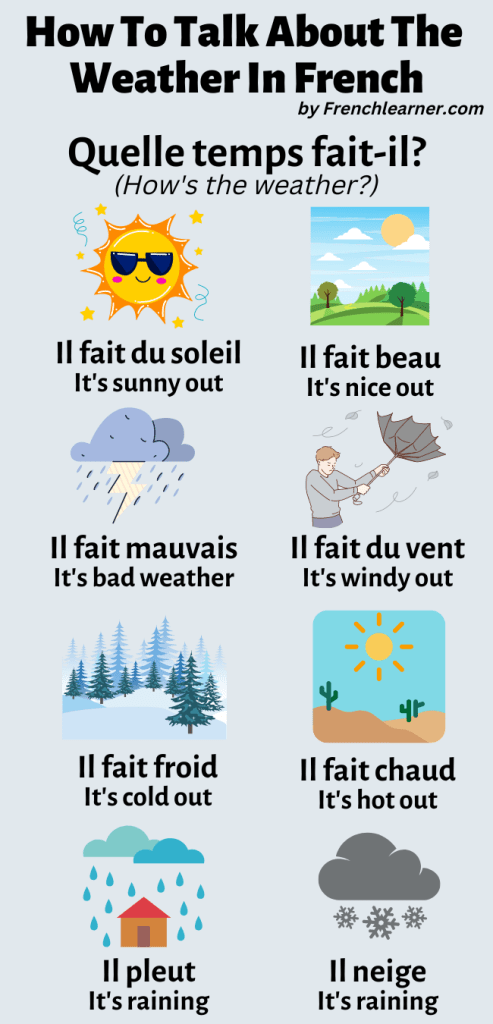
To ask, “How’s the weather?”, say “Quel temps fait-il?“
To describe the weather say, “Il fait + weather word“. The rules for how to say the weather are as follows:
- Il fait + adjective (Il fait beau, it’s nice out);
- Il fait du + noun (Il fait du vent, it’s windy out); and
- Il + verb (Il neige, it’s snowing)
In the following lists of French weather vocabulary we split the terms in to these three categories. We’ve also included lots of fun weather expressions such as il fait un froid de canard (it’s freezing out!).

Essential French Weather Vocabulary
Il fait + adjective
The first group of weather terms consist of adjectives. The grammatical structure is il fait + weather adjective. Il fait is an impersonal expression that translates literally to “it makes”.
To describe the temperature (la température), say “Il fait + number + degrés). For example, “Il fait vingt-cinq degrés” (It’s 25 degrees).
- Il fait beau. It’s nice out.
- Il fait chaud. It’s hot out.
- Il fait froid. It’s cold out.
- Il fait frais. It’s cool out.
- Il fait mauvais. It’s bad weather.
- Il fait humide. It’s humid out.
- Il fait nuageux. It’s cloudy out.
- Il fait orageux. It’s stormy out.
- Il fait _ degrés. It’s _ degrees out.
- Il fait doux. It’s mild weather.
Il fait du + noun
The next group of terms consist of nouns. The grammatical structure is: “Il fait + noun”.
- Il fait du soleil. It’s sunny out.
- Il fait du vent. It’s windy out.
- Il fait du soleil. It’s sunny out.
- Il fait du brouillard. It’s foggy out.
Il + verb
The third grammatical structure is “Il + verb”. For this group “il “translates to “it”. The following a weather-related verbs: pleuvoir (to rain), neiger (to snow) and geler (to be freezing).
Note that a common mistake is to say, “Il fait pleut” or “Il fait neige”. For this group, be sure to omit the “fait”.
- Il pleut. It’s raining.
- Il pleut à verse. It’s pouring out.
- Il neige. It’s snowing.
- Il gèle. It’s freezing.
Il y a + noun
Another grammatical structure is: “Il y a + noun”. The literal translation of il y a is “there is”.
- Il y a du soleil. It’s sunny out.
- Il y a une éclaircie. There’s a sunny interval.
- Il y a un arc-en-ciel. There’s a rainbow.
- Il y a une forte pluie. It’s raining hard.
- Il y a une averse. There’s rain shower.
- Il y a de l’orage. There’s a storm.
- Il y a une tempête. There’s a storm.
- Il y a du bruillard. It’s foggy out.
- Il y a de la neige. It’s snowing out.
French weather vocabulary: Common words
The following is a list of commonly used French vocabulary words:
- le tonnerre thunder
- l’éclair lightning
- la grêle hail
- le soleil sun
- le nuage cloud
- la pluie rain
- la glace ice
- la tempête storm
- le flocon de neige snowflake
- l’averse (f) rain shower
- l’arc-en-ciel (m) rainbow
Extreme weather
- le cyclone tropical tropical cyclone/typhoon
- l’ouragan hurricane
- la tempête de neige blizzard
- la tornade tornado
- la canicule heatwave
- la vague de froid cold snap
- la sécheresse drought
- le déluge downpour
- l’inondation (f) flood
Weather verbs
- Le soleil brille. To shine The sun is shining.
- Le vent souffle. The wind is blowing.
- Un orage éclate. A storm is breaking.
- Les températures dépassent trente degrés. The temperature is above 30C.
- Les températures baissent. The temperature is falling.
French weather idioms
The French love to use lots of fun idioms to talk about the weather. “Il fait un temps de chien” means “It’s horrible weather” but translates literally to “It makes the weather of a dog”.
Another fun French weather idiom is “Il fait un froid de canard”. This means “It’s bitterly cold out” but translates literally to “It makes a cold of duck”.
- Un temps de chien horrible weather.
- Il tombe des cordes. It’s pouring out.
- Il pleut à seaux It’s raining buckets.
- Il fait un froid de canard. It’s very cold out.
- Il fait un soleil de plomb. It’s very hot and sunny.
- Ça caille! It’s freezing (slang).
Expressions for talking about the weather
In French, to express being cold or being hot, you must use the verb avoir (to have). Thus, “J’ai froid” means “I’m cold” but translates literally to “I have cold”.
“J’ai chaud” means “I’m hot” but translates literally to “I have hot”.
- J’ai froid. I’m cold.
- J’ai chaud. I’m hot.
- Je ne support pas le froid. I can’t stand the cold.
- Je ne support pas la chaleur. I can’t stand the heat.
- Je préfère la chaleur. I prefer the heat.
- Je transpire. I’m sweating.
- Je frissonne. I’m shivering.
More French weather terms
The following is a list of French weather terms which you might hear on the weather forecast on TV, which is called “la météo”.
- un baromètre barometer
- Celcius Celcius
- centigrade centigrade (adj)
- un degré degree
- Fahrenheit Fahrenheit
- moins minus
- plus plus
- la température temperature
- dessus zéro above zero
- dessous zéro below zero
- le thermomètre thermometer
- les prévisions météo weather forecast
- le bulletin métérologique weather report
- le climat climate
- un climat tropical tropical climate
- l’atmosphère (f) atmosphere
Related posts:
French vocabulary | Word of the day



Bonjour Michelle – Thanks for catching this! -David
Why are you adding a “t” on “quel temps fait-il”? It’s not “fait t-il”. Because of liaison, there is no reason to add a “t” after “fait.”