


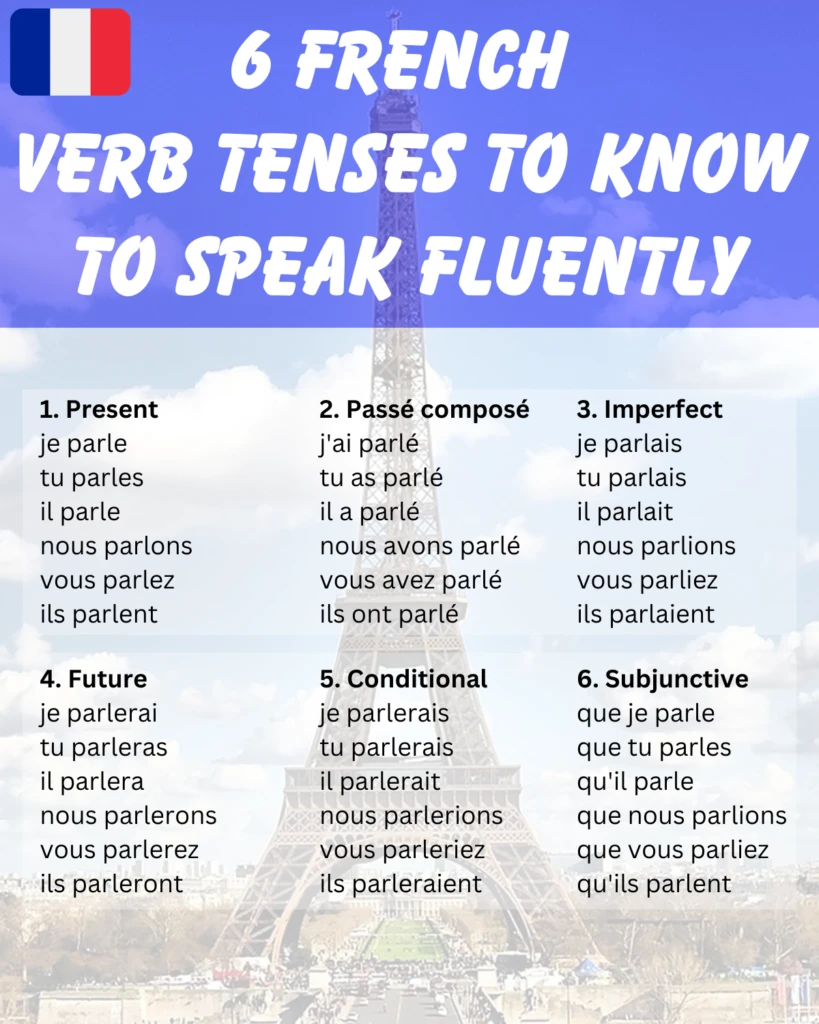
Learning verb tenses can be one of the biggest challenges for many students. This is because there are a lot of tenses and it is difficult to decide which ones are the most important. In a nutshell, if you want to reach a decent level in spoken French, start with learning the following six verb tenses (explained below).


Most important French verb tenses
- Present tense (le présent)
- Compound past (passé composé)
- Imperfect (l’imparfait)
- Simple future (le futur simple)
- Conditional (le conditionnel présent)
- Present subjunctive (le présent du subjonctif)

My name is David Issokson. I’ve spent my whole life learning French and now I’m a full time teacher. When I first faced French verbs in 1987 in junior high school I was baffled by the subject of verb tenses. In this article I’d like to help you by explaining which verb tenses you should focus on in your studies.
If you look at a French verb conjugation website such as WordReference you’ll find that are many tenses. Actually, 17 in total!
Actually, I suggest focusing on six tenses. If you get really comfortable with these six tenses and know how to use them inside and out then you’ll be perfectly well equipped to engage in fluent French conversation.
1. Present Tense (le présent de l’indicatif)
The first tense which you’ll need to focus on the present tense, also called the present indicative. For this simple article we’ll use the verb, parler which is a regular ER verbs and means “to speak”. Here’s the conjugation:
Je parle I speak, am speaking
Tu parles You speak, are speaking (familiar)
Il/elle/on parle He, she, one speaks, is speaking
Nous parlons We speak
Vous parlez You speak (plural, formal)
Ils/elles parlent They speak
Simply put, in the first-person singular form (je, meaning “I”) je parle means “I speak” or “I am speaking”. This is the most basic and important French verb tense.
One common mistake is for people to say “Je suis parle” when they want say “I am speaking”. The correct way to say this is simply: “Je parle” because the “I am + ing” bit is built into the verb.
However, if you just speak in the present tense you might make yourself understood. But, you won’t be able to express yourself very effectively. So, there are more tenses you’ll have to learn.
2. Compound past (le passé composé)
The second tense which you’ll have to learn is called the passé composé. Simply put, this is the past tense. Let’s take a look at it using the verb parler.
J’ai parlé I spoke
Tu as parlé you spoke (familiar
Il/elle/on a parlé He, she, one spoke
Nous avons parlé We spoke
Vous avez parlé You spoke (plural, formal)
Ils/elles ont parlé They spoke
In the “je” form j’ai parlé: “I spoke”. You use this tense to describe actions which occurred in the past at specific times.
For example, if you wanted to say, “I spoke to Marie at 6 o’clock” you’d use the past tense. “J’ai parlé à Marie à six heures“.
3. Imperfect tense (l’imparfait)
With just the present tense and the passé composé you can talk about what you’re doing and what you did. However, if you want to describe actions which you used to do or actions that took place over a period of time you must use the imperfect tense or l’imparfait. This tense is also used for describing the background of stories.
Je parlais I used to speak, was speaking (or spoke)
Tu parlais You used to speak, were speaking
Il/elle/on parlait He, she, one used to speak, was speaking
Nous parlions We used to speak, were speaking
Vous parliez You used to speak, were speaking
Ils/elles parlaient They used to speak, were speaking
There’s no direct translation in French for “used to” because the French language requires the usage of the imperfect tense. The same goes for “was verb + ING”. Thus, je parlais is also “I was speaking”.
4. Future Tense – le futur simple
Just as the name implies, use this tense to talk about events which will occur in the future. The futur simple is formed by combining the infinitive of the verb with the present tense ending of the verb avoir (to have).
Je parlerai I will speak
Tu parleras You will speak (familiar)
Il/elle/on parlera He, she, one will speak
Nous parlerons We will speak
Vous parlerez You will speak (formal, plural)
Ils/elles parleront They will speak
In addition to the futur simple there’s another tense that you can use for describing future actions. This is called the near future tense or futur proche. The futur proche is used for future events which have a higher degree of certainty of occurring.
The grammatical construction for the futur proche is: aller (to go) in the present tense + infinitive. For example:
Je vais parler. I’m going to speak, will speak
5. Conditional – le conditionnel présent
After the future tense you will want to focus on the conditional tense (le conditionnel). The conditional is used for expressing hypothetical actions. It is the “would” tense.
Je parlerais I would speak
Tu parlerais You would speak (familiar)
Il/elle/on parlerait He, she, one would speak
Nous parlerions We would speak
Vous parleriez You would speak (plural, formal)
Ils/elles parleraient They would speak
As you can see construction of this tense is very similar to the futur simple. Take the infinitive then put on the appropriate endings. The conditional endings are the same as the imperfect endings (see above). Here’s an example of a sentence using the conditional tense.
Je parlerais français si j’avais un bon prof. I would speak French if I had a good teacher.
6. Present subjunctive (le subjonctif)
The subjunctive mood can be very challenging for many students. The subjunctive is used to express wishes, emotions and doubts and often requires two subjects separated by que (that).
que je parle that I speak
que tu parles that you speak (familiar)
qu’il/elle/on parle that he, she, one speaks
que nous parlions that we speak
que vous parliez that you speak (formal, plural)
qu’ils/elles parlent that they speak
The following is an example sentence using the French subjunctive.
Je veux que tu parles francais. I want you to speak French.
Of all the verb tense on this page, learn the subjunctive last. It is more advanced and confusing. It’s a better idea to master the present, past and future first.
7. Imperative mood – l’imperatif
The imperative mood is used to give commands and make suggestions. For example in English if you said, “Speak!” as in “Speak to me!”
Affirmative imperative:
Parle! Speak! (tu, familiar)
Parlons! Let’s speak!
Parlez! Speak! (vous, formal and plural)
Negative imperative:
Ne parle pas! Don’t speak!
Ne parlons pas! Let’s not speak!
Ne parlez pas! Don’t speak!
Related lessons
- Top 10 verbs
- Top 100 verbs
- French verb drills
- Present tense
- Passé composé
- Imperfect tense
- Future tense
- Conditional tense
- Subjunctive mood
- Imperative mood
- 4 ways to say ING in French
French grammar | Lessons by David Issokson



Really nicely explained…. precise and to the point… better than my teacher at school!
I know what you mean now, sorry. What I meant was the ending, they are identical to those of imparfait (e.g. -aient in plural 3) adding the -er before (at least with this verb).
One remark, regarding conditionnel: “As you can see construction of the tense is very similar to the future”
For me it is rather similar to the imparfait tense.
Helpful indeed, merci
Very helpful! Thank you. 🙂